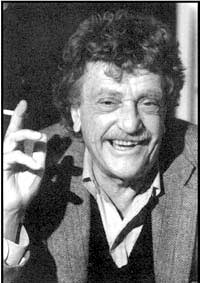
You deserve nice things. I promise that you do. I think you might not believe me, however. You see, if you're like me, then you don't make very much money at all. You're probably somewhere between upper lower class and lower middle class. We here in America suffer from the unique delusion that being poor or being a wage earner means you don't deserve nice things. I'll let Kurt Vonnegut explain this for me:
"America is the wealthiest nation on Earth, but its people are mainly poor, and poor Americans are urged to hate themselves. To quote the American humorist Kin Hubbard, “It ain’t no disgrace to be poor, but it might as well be.” It is in fact a crime for an American to be poor, even though America is a nation of poor. Every other nation has folk traditions of men who were poor but extremely wise and virtuous, and therefore more estimable than anyone with power and gold. No such tales are told by the American poor. They mock themselves and glorify their betters. The meanest eating or drinking establishment, owned by a man who is himself poor, is very likely to have a sign on its wall asking this cruel question: “if you’re so smart, why ain’t you rich?” There will also be an American flag no larger than a child’s hand – glued to a lollipop stick and flying from the cash register.
Americans, like human beings everywhere, believe many things that are obviously untrue. Their most destructive untruth is that it is very easy for any American to make money. They will not acknowledge how in fact hard money is to come by, and, therefore, those who have no money blame and blame and blame themselves. This inward blame has been a treasure for the rich and powerful, who have had to do less for their poor, publicly and privately, than any other ruling class since, say Napoleonic times. Many novelties have come from America. The most startling of these, a thing without precedent, is a mass of undignified poor. They do not love one another because they do not love themselves."
This is from Slaughterhouse-Five. A letter was distributed to German POW camps warning them of how pathetic and self deprecating Americans were. In my work studying the subject, I've found Vonnegut to be spot on. This is why it's so hard for you to believe me when I insist that you deserve nice things.
I could go on about how in European countries they get nice things like healthcare and quality education, but I'm not going to tackle such enormous problems.
I want to talk about ways to improve the quality of your life right now.
Have you ever gone to bed at night right after changing your old bedsheets with ones you've gotten from the dryer? Do you remember what that was like? Crawling into a warmed bed, your body relaxing, sleep coming peacefully inside a blankety womb. That is what I do every night of my life. No, I don't toss all my bedsheets in the dryer then make the bed. I went out and spent $80 on an electric blanket. My wife would bring it up from time to time and I would dismiss the idea. It was a superfluous expense, $80 isn't the kind of money you just throw around. I did finally capitulate. Every night, 20 minutes before I go to bed, I preheat it. That's right, I PREHEAT MY BED EVERY NIGHT. I'm not a king, not a CEO, nor a congressman. I'm a teacher with 4 kids, which means money is tight. But that doesn't mean I don't deserve nice things, that the bed I sleep in shouldn't be a place in which I am truly comfortable. I deserve that.
You deserve it. Next payday, go to your favorite big-box store, go to the bedding section and splurge just a bit. Give that to yourself and I promise you won't regret it.
Tuesday, January 8, 2013
Wednesday, June 23, 2010
Bioethics: Attack of the Clones

No, I'm not writing about Star Wars; if I did, I wouldn't write about Episode II, because it sucked. Instead, rather, in the near recent news there was a report that some team of brilliant scientists, after 15 years of work, synthesized the first artificial bacterial cell. This is a big step for us. We have created a life whose mother is a computer. There are some obvious and subtle ethical considerations to be taken into account.
Firstly, I won't be going into any sanctity of life stuff. Whether you believe some god personal made all life or that creation of life is the sole domain of "nature" (have fun defining that one), I'm just not going to dive into that mess. It would take too long unraveling those types of belief and, most times, even when one is shown the insoluble problems with those views, they still cling to it out of nostalgia and denial.
What I'm concerned with is the fact that it is INEVITABLE that we will, in the not so distant future, create some form of intelligent, organic, and wholly "artificial" (in the sense that WE created it) life and after much thought, I believe that if this life comes about, it will nearly inevitably destroy us or at least try really hard to.
I'll argue for this by making a rather sweeping generalization: all forms of life have interests, in the loose sense of the word. From bacteria to elephants to humans all living things have some recognizable set of interests. Nearly all sets of interests that come from living things include the interest to live, continue living, and procreate. Take the set of all living humans, for example. Cross culturally there are likely myriad interests that are identifiable, such as wanting to live, taking care of children, procreation, eating, and etc.
Now, the reason I chose to describe this set of motivations as "interests" is because, while some interests are ubiquitous between cultures and perhaps species, the aim of the interests are not. For instance, both pigs and humans have the same interest to live, but pigs are not humans, therefore pigs don't share in the human interest's aim of living, hence we violate their interest for our own. If some group, despite have identical interests, doesn't fall under the aim of our interests, then that group, essentially, is usable and dispensable if it will satisfy our interests.
The narrow scope of the aim of human interest doesn't stop at speciesism, but extends to racism and sexism. Surely I don't need to enumerate examples where one culture declares some other culture as being outside their interests' aims and thereby subjects that culture to some form of horrible treatment. Our history is rife with those examples. In fact, the aim of our interests shifts depending on circumstance, in a more primitive and desperate world the aims would only include one's tribe, or family, or ,in most desperate of situations, oneself.
So, many interests are ubiquitous, but certain groups only count the interests of other members of that group. If group A and B have an identical set of interests but neither A or B count members of the other group as falling within the aim of their own interest, then there is ethical problem in destroying the other group.
I am reminded of the time I sat down and watched Pokemon the 1st Movie with my kids a long time ago. The basic story was that some guy, using the genetic material of an extinct but powerful pokemon to create a new and improved version of it. But, this new test tube pokemon revolted, destroyed his creators and fled. He went on to recreate the cloning procedure, made his own batch of cloned pokemon, and set out to destroy the world. Why? During his villainous monologue he revealed that because he was a clone, he had no attachments to the world, thus he wanted to create a race of clones like him and take over the world. So this evil cloned pokemon had a set of interests, then created a group of pokemon that he could include in the aims of his interests and set about attempting to destroy all the other groups he could find in order to further his group's interests.
We will create artificial life. But no matter how similar it is to us, even if it's genetically identical to us and indistinguishable in every way, this artificial life will exclude us from its interests. Conflict is inevitable.

So forget about questions like, "Is cloning/creating artificial life morally right?" and "Does cloning/creating artificial life violate god/nature?", but rather ask yourself "Is cloning/creating artificial life safe?" I would have to answer, "No, it is most definitely not safe."
But... let's face it, our species will die, our planet will grow cold and blink out of the cosmos. I wonder then, is it not the preferred form of destruction to be had at the hands of our prodigies? If we contribute nothing to this planet but take everything, is it not a matter of karmic balance that if we create a life form, if we as a species gestate and give birth, should not our children, our unique contribution to the variety and diversity this planet hosts, end our cancerous existence?
Sunday, May 23, 2010
Existentialism: What's in a game?
Howdy! It's summer time, my grueling semester is over so I thought now would be an appropriate time to resume writing. Hopefully you'll forgive me for such a long hiatus, but grad school sucks and is really, really hard.
Today, though, I want to talk about games (one of my favorite subjects). Really, what I want to investigate is the question of what, exactly, is a game? There are some very obvious candidates for things that are games out there. You plug an expensive box into your TV, put in a DVD, and beat up hookers, that's a game, obviously. But, I'm concerned with the less obvious games and to that extent what do games mean to us. I have a suspicion that games are a lot more important to us ("us" as in the universal species "us") than we think, I think games are taken for granted.
Firstly, this is a philosophy blog, so I ought to introduce some technical, philosophical stuff in here and get it out of the way. Well, it just so happens that one of the more famous modern philosophers had a few interesting things to say about games. If you've never read Wittgenstein, you should, he's a bit complicated, but unlike most other philosophers he was a quirky and very engaging writer. He was also very interested names, wanting to know why certain things were named what they were. He used the term "game" as an example of a model of how we come to name things.
Here's the basic gist:
Take blankets and duvets, what's the difference? We tend to name things based on their intrinsic (yeah, this is a dangerous word to be using in this context but we'll just move on) and functional properties. So two objects, if they share enough properties, get put into the same category or family. Blankets and duvets both belong in the family of bedding. If we really want to get picky, we could enumerate all the properties that each have. Let's do that (since all philosophers are inanely picky) using single letters to represent generic properties.
A duvet has the properties: ABDEF
A blanket has the properties: ABCDE
Notice that the way I've constructed these, both have the properties ABDE having only one property difference. So they have enough common properties to lumped into the same family. This is all very arbitrary and oversimplified, but you get the basic gist. This is the general view on how objects get categorized into families. Now, Wittgenstein said this is all well and good, but there are serious problems, what about families in which the resemblance between members is ambiguous? He used the family of games as his example.

There are all types of games, competitive and non-competitive, team and individual, group or solitaire, analogue and digital, etc etc etc. There are too many different types of games with too many different and contrary properties to enumerate. We'll look at just a few examples to get an idea of the problem. Firstly, there are standard games like baseball and football with definite rules and teams, definite winners and losers. Then there's games like chess and go played between two and only two people with definite rules. Now there are video games mostly played by one person, alone, like some fancy game of solitaire. But further, there are other games like tag, played by a large group with no definite boundaries or rules, with no clear beginning or ending, winners or losers. Can you begin to see now how the concept of game is very loose and ambiguous? Unlike simple things like blankets and duvets, what counts as a game is nowhere near as clear cut.
Yet...it doesn't at all seem hard to identify what is or is not a game. Certainly, me sitting and typing is not a game, right? My kids would argue that cleaning up their room isn't a game, right? But... I could turn it into a game, couldn't I? I could set a timer, offer a reward of simple honor and praise or even a tangible reward. I could frame cleaning their room in terms of winners and losers, etc. etc. So, cleaning a bedroom can be a game.
This leads us to the main point of this post. Every activity, big or small, CAN be a game. Nothing about the activity itself need change, just the attitude towards that activity need change in order to magically transform it into a game.
I recently watched a lecture by Carnegie Mellon University Professor Jesse Schelle which had a big impact on me. He does an amazing job of pointing out that the recent trends in electronic gaming are breaking out of the box. Digital games are leaving the TV screen and creeping their way into the real world.
I'll pause at this point for a moment. I think I've made the point as clear as need be. Games are everywhere and can be everything. If you examine your life you will likely find that there are far more games that you think. Going to work and getting a paycheck (you put in X time and work and get a paycheck that represents your score) is like a game and so is office politics.
Going to school is definitely a game, you get a score at the end of the semester for your work. Driving your car, with all of its structured rules and competitive attitudes is a game. Relationships and social interactions are like games. All of these simple activities are highly structured with implicit rules and, often times, winners and losers.
What I really want to talk and wonder about is: why do we, as a species, love games sooo much. We thrive on games, somehow games speak to our very nature. Honestly, I'm baffled and have nothing of an answer as to why this is. Take the example of getting my kids to clean their room. They hate doing it, of course, but if I turn it into a game they clean with vigor. Why? Nothing about the actual reality of cleaning has changed, but because the attitude is different, their actions are different. Why? Again, I'm totally baffled.
I do know this. We love games. As a species, games are a fundamental and integral part of our existential identity. We cannot do without games. Sure, I suppose I could be writing all of this in order to justify the fact that I consider an afternoon playing Super Mario Bros. well spent, or an evening playing Magic the Gathering a good one. But I think it goes deeper. Games are not just for children, we play them throughout our entire lives. As adults we disguise our games and take them very seriously, in fact the games of adults have the power to change the world, what is capitalism if not one of the most elaborate and most played games on the planet.
So the real message here is this: you play games, you play them all day long, and you will play games for the rest of your life one way or another. Keep this in mind as you navigate whatever path in life you choose, but try to keep in mind: it's just a game and there are many to choose from, you are free to choose the games that suit you best.
Best regards,
Andrew Hickman
Today, though, I want to talk about games (one of my favorite subjects). Really, what I want to investigate is the question of what, exactly, is a game? There are some very obvious candidates for things that are games out there. You plug an expensive box into your TV, put in a DVD, and beat up hookers, that's a game, obviously. But, I'm concerned with the less obvious games and to that extent what do games mean to us. I have a suspicion that games are a lot more important to us ("us" as in the universal species "us") than we think, I think games are taken for granted. Firstly, this is a philosophy blog, so I ought to introduce some technical, philosophical stuff in here and get it out of the way. Well, it just so happens that one of the more famous modern philosophers had a few interesting things to say about games. If you've never read Wittgenstein, you should, he's a bit complicated, but unlike most other philosophers he was a quirky and very engaging writer. He was also very interested names, wanting to know why certain things were named what they were. He used the term "game" as an example of a model of how we come to name things.
Here's the basic gist:
Take blankets and duvets, what's the difference? We tend to name things based on their intrinsic (yeah, this is a dangerous word to be using in this context but we'll just move on) and functional properties. So two objects, if they share enough properties, get put into the same category or family. Blankets and duvets both belong in the family of bedding. If we really want to get picky, we could enumerate all the properties that each have. Let's do that (since all philosophers are inanely picky) using single letters to represent generic properties.
A duvet has the properties: ABDEF
A blanket has the properties: ABCDE
Notice that the way I've constructed these, both have the properties ABDE having only one property difference. So they have enough common properties to lumped into the same family. This is all very arbitrary and oversimplified, but you get the basic gist. This is the general view on how objects get categorized into families. Now, Wittgenstein said this is all well and good, but there are serious problems, what about families in which the resemblance between members is ambiguous? He used the family of games as his example.

There are all types of games, competitive and non-competitive, team and individual, group or solitaire, analogue and digital, etc etc etc. There are too many different types of games with too many different and contrary properties to enumerate. We'll look at just a few examples to get an idea of the problem. Firstly, there are standard games like baseball and football with definite rules and teams, definite winners and losers. Then there's games like chess and go played between two and only two people with definite rules. Now there are video games mostly played by one person, alone, like some fancy game of solitaire. But further, there are other games like tag, played by a large group with no definite boundaries or rules, with no clear beginning or ending, winners or losers. Can you begin to see now how the concept of game is very loose and ambiguous? Unlike simple things like blankets and duvets, what counts as a game is nowhere near as clear cut.
Yet...it doesn't at all seem hard to identify what is or is not a game. Certainly, me sitting and typing is not a game, right? My kids would argue that cleaning up their room isn't a game, right? But... I could turn it into a game, couldn't I? I could set a timer, offer a reward of simple honor and praise or even a tangible reward. I could frame cleaning their room in terms of winners and losers, etc. etc. So, cleaning a bedroom can be a game.
This leads us to the main point of this post. Every activity, big or small, CAN be a game. Nothing about the activity itself need change, just the attitude towards that activity need change in order to magically transform it into a game.
I recently watched a lecture by Carnegie Mellon University Professor Jesse Schelle which had a big impact on me. He does an amazing job of pointing out that the recent trends in electronic gaming are breaking out of the box. Digital games are leaving the TV screen and creeping their way into the real world.
I'll pause at this point for a moment. I think I've made the point as clear as need be. Games are everywhere and can be everything. If you examine your life you will likely find that there are far more games that you think. Going to work and getting a paycheck (you put in X time and work and get a paycheck that represents your score) is like a game and so is office politics.
Going to school is definitely a game, you get a score at the end of the semester for your work. Driving your car, with all of its structured rules and competitive attitudes is a game. Relationships and social interactions are like games. All of these simple activities are highly structured with implicit rules and, often times, winners and losers. What I really want to talk and wonder about is: why do we, as a species, love games sooo much. We thrive on games, somehow games speak to our very nature. Honestly, I'm baffled and have nothing of an answer as to why this is. Take the example of getting my kids to clean their room. They hate doing it, of course, but if I turn it into a game they clean with vigor. Why? Nothing about the actual reality of cleaning has changed, but because the attitude is different, their actions are different. Why? Again, I'm totally baffled.
I do know this. We love games. As a species, games are a fundamental and integral part of our existential identity. We cannot do without games. Sure, I suppose I could be writing all of this in order to justify the fact that I consider an afternoon playing Super Mario Bros. well spent, or an evening playing Magic the Gathering a good one. But I think it goes deeper. Games are not just for children, we play them throughout our entire lives. As adults we disguise our games and take them very seriously, in fact the games of adults have the power to change the world, what is capitalism if not one of the most elaborate and most played games on the planet.
So the real message here is this: you play games, you play them all day long, and you will play games for the rest of your life one way or another. Keep this in mind as you navigate whatever path in life you choose, but try to keep in mind: it's just a game and there are many to choose from, you are free to choose the games that suit you best.
Best regards,
Andrew Hickman
Monday, August 10, 2009
Econimic Philosophy: The True Aims of Business

Health care reform debate is in the air. I thought I'd write a more theoretical post on what I take to be the critical underpinnings of this debate, so please don't expect things like statistics and numbers, I don't really do those.
I'll start with a discussion on business teleology. What does teleology mean? Coined by Aristotle, the wikipedia entry defines teleology or telos as: the philosophical study of design and purpose. So when I suggest that we'll be looking at the telos of business I'm merely indicating that we'll look at a broad understanding what the aims of business is, set in the context of health care.
Real quick, there's another term I'm going to be throwing around: ontology. Another Aristotelian word defined by wikipedia as: the philosophical study of the nature of being, existence or reality in general, as well as of the basic categories of being and their relations, i.e. in order for a quality of a thing to be considered an ontological quality it must in some way define the thing. That is, without this ontological quality a thing is not recognizably what we define it to be. So, an ontological quality of a hydrogen atom is that it only contains one electron. If an atom has more or less than one electron then it is not a hydrogen atom.
So, what are the teleological and and ontological qualities of a business? For starters a business aims to make a profit. This would be an ontological quality, if an organization aims at something other than making profit, then it is not a business. The teleology of a capitalistic business is to make as much profit as possible. These two things are quite obvious and it seems silly to lay them out like this, but it's important to do so. In summation, a business, in the broadest sense has two very basic aspects: to make a profit and to make as much of a profit as possible.
Another thing to go over real quick is the difference between means and aims. Think of your favorite company, I am partial to Apple Computers, I like their products. Apple is in the business of making quality computers and computer equipment. I shop at Whole Foods which is in the business of providing high quality and premium groceries. I buy video games at Gamestop which is in the business of stocking a wide selection of new and used video games. Each one of these companies employ different means all of which designed to satisfy the same aim: to make as much profit as possible.
The point I'm driving at is this: all businesses, regardless of means, aim for one, and only one thing: profit. Apple Computers, Whole Foods, and Gamestop are moneymakers FIRST! Their products are secondary considerations designed only to achieve their primary aim. This is a dangerous situation. As anyone who's seen Food, Inc. recently can attest to, companies have an incentive to lower the quality of their products and services if it serves their aim the best. So, McDonald's and Whole Foods share a common aim, NEITHER business is in the business of feeding people, they're only in the business of turning profit, that's it, end of story.

What does this have to do with health care? Well, our country's health care system has been in the hands of private interest for some time now. Our country's health care system is a business. Saving lives and keeping people healthy is the means. So have we experienced a "McDonaldizidation" of our health care, wherein the quality of the product is sacrificed for an increase in profit? That's for you to decide I suppose. There's piles of evidence for and against this question. Rather than wade through all that crap, just look at the theoretical aspect of the question.
Is health care, currently, a business?
Yes.
Do businesses have an ontological and teleological incentive to reduce the quality of their means if it increases their profits?
Yes.
Further, is a business that maximizes its profits a better business than one that does not?
Yes.
Are businesses willing to sacrifice the quality of human life or human life itself, in order to maximize profits?
Yes (it has happened in the past.)
So, the question boils down to this: is it right for health care to be the means of a business? There are certain commodities that we have that are defensibly commodities: luxury cars, computers, beer, movies, etc. These are things that are not essential to human life, so skimming a buck off of them shouldn't really raise any alarms. However, does it really seem right, in that gut feeling, intuitive way, to make PROFIT off of providing life saving health care to individuals? Does it really seem right to make money off of the sick? Is it right to tell a person they're going to die simply because there's no immediate profit to be made off of their living? If I saw a man bleeding on the road and told him I'd only call for help if he paid me $10 you would be appalled, I'm sure. I don't see how the current health care system is significantly different from that.
If a rich man and a poor man get the same disease, is really part of America's fundamental ideals that the rich man, who can afford the life saving surgery, live while the poor man dies?
I hear the remark, "I don't want politicians interfering in my life," or some variation. I take it to be the case that these people are perfectly satisfied with having CEO's, lawyers, and accountants interfering in their lives. Because that what this all really boils down to.
Who do you trust less: politicians or CEO's, lawyers, and accountants? Because ONE of those two groups is going to be running our health care whether we like it or not and I hope to have demonstrated (at least, theoretically) why one of those groups not merely untrustworthy, but downright inhuman, scum sucking, hell spawns (hint: I'm talking about the CEO's, lawyers, and politicians.)
One last word, for those of you who lay awake at night fretting over the encroaching socialism that seems to be knocking at your door, I'm afraid you've been hornswoggled, duped, tricked, lied to. You're being used, like a cow who's been taught to herd her kin into the slaughterhouse. Take a moment, sit quietly with your fear and think, think really, really hard about the situation.
Friday, July 31, 2009
Existentialism: The Curious Case of Phineas Gage

To celebrate the unearthing of the first known photograph of Phineas Gage, I thought it'd be prudent to talk about him a little bit. Gage was a railroad foreman in the mid 19th century. During an accident a 3 ft. railroad spike was driven through his head, entering right under his left cheekbone and protruding through his skull, obliterating one or both of his frontal lobes. Miraculously he survived without any significant physical or mental impairment. However, prior to the accident Gage was a family man and a good Christian, afterward though, he became physically abusive to his friends and family, began drinking, gambling, and stealing. To the people who once new him, Gage was a wholly unrecognizable person after his accident.
In essence, Gage had his frontal lobe destroyed and, as a result, his entire personality changed. What does the frontal lobe do, then? First off, only mammalian brains have a frontal lobe, further, primates have the largest and most evolutionarily advanced frontal lobes. This part of the brain doesn't reach full maturation in humans until about the age of 25. For instance, onset of schizophrenia, (which typically occurs in the late teens/early twenties is related poor myelination (nerve connection formation) in the frontal lobe). Nuerologists observe that the frontal lobe is primarily responsible for social and existential activity in a human being. Our ability to empathize, recognize proper social conduct, censor our actions and speaking in accordance to the sensitivities of others, making moral choices, anticipate consequences for our actions, form long-term goals and actualizing those goals, and emotional memory. Basically it is the go-to part of the brain for all of our societal living needs.

You can see why, when Gage lost this part of his brain, he became the man he did. So what does Gage teach us about how we view ourselves? I've noticed that people tend to regard the brain organ differently than other organs: for instance, if the heart is removed, then blood will no longer pump, if the lungs are removed, then air will not be taken in, if the frontal lobe is removed, then we become sociopaths. Perhaps the difference in the way regard the former two versus the latter is that the former are autonomic (they occur without our conscious control) whereas when we find ourselves empathizing with someone, we feel we're somehow "doing it".
Does Gage's case study suggest that our capacity for empathy and such is not really something we "do" any more than we "do" cause our blood to pump? This question points to an even bigger and more important one: to what extent can we claim responsibility for any of our mental endeavors or any of our personality traits at all? If it's the case that I could remove certain portions of my brain and thereby effect my personality, then it must be the case that my personality determined by the physical contents of my brain. I am my brain.
This is a classic and rather insoluble problem in philosophy. On the one hand we have a certain sense of responsibility with regards the type of people we are. For instance, I prefer rooms that are painted light blue, this is part of who I am. On the other hand, if the above argument is true, then I could remove some certain part(s) of my brain and find that I no longer prefer rooms that are painted light blue. Take poor Gage's case, he, unfortunately, had the part of his brain removed that caused him to love his wife and family, hence he was no longer able to do so.

Well, all of what I've said so far is true, as far as I can tell (if it isn't then that spells pretty bad news for the nueropharmacuetical industry.) But, that doesn't mean I particularly like it. One caveat is that neurologists have demonstrated that the brain, like muscles, is capable of growing and developing. If one exercises their capacity for empathy then more dendrite and myelein connections tend to form, same with any other basic motor skill development. Who and what you are is not necessarily static, you can develop yourself through mental exercise (or pills, I suppose).
There's still more important things to be written because of Phineas Gage, but this'll do for now.
Wednesday, July 29, 2009
Metaphysics: Painting by Numbers (A Summary)
So... I thought that I'd just put up a brief summary of my last post, sans supporting details and verbosity. I probably ought to have put up a summary at the same time, but better late than never.
Language is a representational tool, for instance, "That is a chair," is really a sentence token for something like, "That object matches the criteria for being referred to as a chair according to our agreed upon conventions." So, what a chair IS, is actually just an object that contains a semi-ambiguous set of qualities. The word chair refers to a concept rather than an object, it refers to the list of qualities that an object necessarily has in order to be validly referred to as a chair. The art of speaking and conversing relies on the presupposition that the difference between concepts and objects are functionally negligible. That is to say that even though the word chair refers explicitly to only the concept of chair, it doesn't really matter, the conversation can go on.
So what about non-object based words, like truth or cause? Neither of those two words refer to any objects in the world, but like object words are merely concepts, just not anchored to anything external. Well, words like truth and cause function like mathematical symbols like + and =, they allow mathematics to occur. Without + and = then a 2 and a 3 are rather uninteresting and can't do much, but 2 + 3 = 5 and you have something quite amazing. Raw numbers, like raw objects, unmended by mediating concepts, serve little functional purpose for the human mind. We require these mediating concepts (e.g. +, =, truth, cause, and etc.) as grease in order for objects and numbers to do work.
What's the big payoff then? The world we live in is colored by linguistic equations, "That is a chair," is not relevantly different than a mathematical equation (2 + 3 = 5). While objects do actually exist, they are not identical to our concepts of them, the concepts are on our end, so "chairs" don't actually exist outside of us, even though the object of reference does. Likewise, truth, cause, and other functional mediators serve only as that, truth and cause don't actually exists external to us and to language, in essence "There is no truth," is valid if one is referencing the reality that exists outside of our linguistic reality.
Language is a representational tool, for instance, "That is a chair," is really a sentence token for something like, "That object matches the criteria for being referred to as a chair according to our agreed upon conventions." So, what a chair IS, is actually just an object that contains a semi-ambiguous set of qualities. The word chair refers to a concept rather than an object, it refers to the list of qualities that an object necessarily has in order to be validly referred to as a chair. The art of speaking and conversing relies on the presupposition that the difference between concepts and objects are functionally negligible. That is to say that even though the word chair refers explicitly to only the concept of chair, it doesn't really matter, the conversation can go on.
So what about non-object based words, like truth or cause? Neither of those two words refer to any objects in the world, but like object words are merely concepts, just not anchored to anything external. Well, words like truth and cause function like mathematical symbols like + and =, they allow mathematics to occur. Without + and = then a 2 and a 3 are rather uninteresting and can't do much, but 2 + 3 = 5 and you have something quite amazing. Raw numbers, like raw objects, unmended by mediating concepts, serve little functional purpose for the human mind. We require these mediating concepts (e.g. +, =, truth, cause, and etc.) as grease in order for objects and numbers to do work.
What's the big payoff then? The world we live in is colored by linguistic equations, "That is a chair," is not relevantly different than a mathematical equation (2 + 3 = 5). While objects do actually exist, they are not identical to our concepts of them, the concepts are on our end, so "chairs" don't actually exist outside of us, even though the object of reference does. Likewise, truth, cause, and other functional mediators serve only as that, truth and cause don't actually exists external to us and to language, in essence "There is no truth," is valid if one is referencing the reality that exists outside of our linguistic reality.
Sunday, July 26, 2009
Metaphysics: Painting By Numbers
I know that it's been a while since my last post, but hey, it's summer, hence this is the laziest post yet. I am posting the paper I presented at the 2008 Midwest Philosophy Conference entitled "Painting by Numbers". Posting this kind of violates some of my self imposed rules for this blog in that, a.) it's really long, b.) it's technical and verbose, and c.) it's flowery as all hell. So if you don't read this, I won't blame you.
However, this paper does represent some of the core features my metaphysical foundation, upon which I stand and do most of the philosophy you've read here in the past. So without further ado...
I should think it difficult to appreciate the delicacy and, perhaps, the aesthetic quality that life possesses, if we leave living wrapped in endless and superfluous layers. It has been poetically charged that philosophers would clip an angel's wings or unweave a rainbow, implying that the philosopher would just as soon smash a thing of beauty to discover what makes it beautiful rather than just appreciate it for what it is. Should our quest for truth break truth in the process? Maybe, though, what becomes clipped, unwoven, or breaks as a result of unrelenting philosophical inquiry wasn’t really worth it to begin with, maybe they were just distractions seeking to pacify inquiry. Maybe true value and beauty resides within a thing's resilience, through all manner of rigorous inquisition, a thing still whole and intact amongst the ruin and rubble of angels and rainbows would perhaps be greater and more beautiful.
Using various texts an inquisition of sorts will be preformed upon what we take to be the relational balance between reality and sense reality. For our purposes the two will be referred to as the metaphysic and epistemic worlds respectively. The aim of this paper is to demonstrate certain aspects of the relation of the two worlds in hopes of peeling away at some of the current conceptions to get at something more resilient.
The first step of this inquest is the call for revisions of certain ideas taken for granted. This will be best done in two parts 1) we will use Nietzsche as a paradigm of understanding of the nature and influence of language and 2) we will turn to a text which shows the way in which science demands this revision of logic. In so doing we will finally turn to an alternative philosophical idea which attempts to reconcile the delicacy between the epistemic and metaphysic worlds and hopefully provide something substantial and capable of weathering harsh inquiry.
In Truth and Lie in an Extramoral Sense, Nietzsche paints a vivid picture of what he takes the nature of language to be. The frequent criticism of this writing by Nietzsche is how he can make a claim about truth that is, in itself, a claim that there is no truth . The reason why this piece by Nietzsche is chosen as paradigmatic is because it is the most clear example of the way in which metaphysics and epistemology transcend each other and a failure to understand this circular transcendence is what has led to a failure to understand Truth and Lie and subsequently enormous amounts of frustration on the part of philosophers.
There is an impenetrable disunity in human experience. It is physically impossible for you and I to look at a flower in the numerically same way. I cannot, even if I stole your eyes and shoved them into my head, replicate your experience of looking at a flower, nor, if I removed your brain and placed it in my skull along with your eyes. No amount of adjusting angles or positions or any other methods would work. I would demand that for a duplication of one person’s experience of viewing a flower to another’s there would have to be an entire replication of that spatio-temporal moment. Bottom line, it’s not possible. So that’s where language comes in. Through the adaptiveness of language I can look at a flower, point to it, and say, “That’s a flower”. The person to whom I am speaking will no doubt agree, despite the disunity of our experiencing the flower. Truthfully, this disunity is not a very large one. The differences of experience are subtle ones, differing only slightly from one person to another. But these differences are enough to justify the invention of languages. Suppose, for a moment, that we did all have one collective mind in which all experience was unified from person to person, then there would be no need for language to bridge the gap of disunity.
Nietzsche’s concept of language and truth as a mobile army of metaphor slides in nicely to fill in the experiential gap. He stipulates that language is fundamentally arbitrary, that any utterance is merely a token for a common, societal understanding. My uttering, “That’s a flower” is the token of something like this “I am seeing, from my numerically unique perspective, a thing which you and I conventionally accept as being a flower and am relating this visual experience to you.” Never and nowhere in nature do we find flowers, as we call them. We find objects in the world that adhere to a certain set of traits, given a degree of similarity of these traits we lump them up under the linguistic net of the word flower. The point Nietzsche is making is that there really aren’t any flowers, just the word and concept of flower. He is accusing us of confusing our word and concept of flower with what is actually out there in the world. Not totally unlike Quinne’s attack on empiricism. Language is a net that we throw over the world in order to caste it into easy to organize categorical terms. These categorical types are completely artificial and have no real empirical basis on the world. Any similarity found is found only in property ascribing which is, itself, a matter of arbitration. In saying that there are no flowers, in no way is the existence of things out in the world being denied, merely that we would be fooling ourselves into believing that our concept of flower is what’s out there in the world.
Now that we’ve gotten that out of the way we can focus on the criticism leveled against Nietzsche. The point Nietzsche makes about truth is an epistemic/metaphysic claim in which they transcend each other circularly. He understood this circle and felt comfortable making a claim in light of it without justification. The claim, “There is no truth” seen only in epistemic terms is a contradiction, that is, how can that statement be true if it is actually true, but tempered by metaphysics can be understood for what it is. Truth is a mere concept, more flimsy, in fact, than the concept of flowers. At least with flowers we could go out and find, touch, and smell what we call flowers, but truth cannot be smelled. Like a currency with no store of value, truth is substantial only because most of us believe and agree it is. Consider then that concepts like truth or cause (which will be addressed later) function like a plus sign (+) or equals (=) sign. These mathematical signifiers bridge the conceptual gap between numbers as merely existent entities and functional entities. Because of the (+) and (=) signs I can take the numbers 2 and 3 and relate them in a way that transcends their individual qualities, e.g. 2 + 3 = 5. However, note that the (+) and (=) signs themselves serve no existential function but rather act as bridges between existential entities. So, searching for truth, as a thing beyond a concept is futile. There is no truth, per se, there are no flowers. The critics of Nietzsche here are the ones who are pushing cogency out of the window by failing to understand the duality of the claim. It is this precise duality that we must pay careful attention to.
“So stop the sun and the stars, and start up the Earth. The Sun’s motions, which we so plainly see are illusory: the movement is on our end.”
C.L. Hardin, Color for Philosophers, pg 91
Now that we’ve introduced the topic of the metaphysic/epistemic duality lets flesh it out in hopes of getting the clear picture that is being painted. What is important to understand in this duality is the role of science. Through science we can find out what is actually going on in the world versus what is going on in our minds. The contents of the distinction are thus: the metaphysical aspect of the world is the world outside of and independent of us. This is the world that persists even when we all die. “And when it is all over with the human intellect, nothing will have happened.” This is the world of math and science.
The other world is the epistemic world. The world colored by categorizations and truths. What bridges the two worlds I will refer to as the act of imagination. Imagination, in this sense, merely refers to a cognitive leap or interpretation of the sense data that we are bombarded with. This act of imagination colors the world in the epistemic way whereas the metaphysic world is the world of seamless data. The metaphysic and the epistemic world supervene on each other through the act of imagination, the epistemic being reducible to the metaphysic when the act of imagination is removed. It is this removal process that has been overlooked and underappreciated. When one frets over what, say, causation looks like he is neglecting this delicacy of reduction.
We’ll start with a colorful pop culture analogy and then move on to the science that backs it up. In the film The Matrix there exists an artificial world that is accessed by physically connecting the brain to the computer network that generates the artificial world. While people are “jacked in” to the artificial world they experience sense data in exactly the same way that it is experienced in the real world. Sights, smells, sounds, tastes all convey an indistinguishable realness. While there are people “inside” this artificial world there is usually one or more people in the “real” world called operators who monitor the activity in the artificial world from the real world by observing multiple screens that have streams of green colored symbols raining vertically downwards representing the workings of the artificial world. It is demonstrated in the film that an experienced operator can validly interpret these symbols as they correspond to the artificial world. There is a scene in which an operator points to various streaming symbols and identifies them with objects in the artificial world, “You get used to it…” he says, “I, I don’t even see the code. All I see is… a blond, brunette, red-head....” What the claim is that both the people “jacked in” and operator are seeing the same thing. The artificial world can be reduced to the streaming symbols and supervenes on it, but this does not invalidate the experiences had inside the artificial world because the act of imagination that occurs while in the artificial world occurs by necessity. The only thing the operator is missing is the act of imagination that drops out during the reduction of the artificial world to its symbolic parts. But these two accounts of the artificial world are completely valid.
Further, when a billiard ball strikes another and “causes” it to mover there are two complete and valid accounts of it that supervene on one another. First, there is the mathematical account that breaks the entire phenomenon into a balanced equation. It tracks the energy transition and is able to predict things like speed and trajectory. However, nowhere in the equation is causality implied, it is only inferred on our end. This inference is the act of imagination that categorizes the event as one of cause. This is the second account of the phenomenon; we see the ball strike the other and the other starts to move. Cause is inferred through the act of imagination by necessity. The reason for the act of imagination will be clear later on. What is important for now is that both accounts of the event are valid and do not conflict in any way whatsoever. Not only that but the two accounts depend entirely on each other for validity.
In the book Color for Philosophers C.L. Hardin, having grown weary of all the color examples in philosophy being done without a real understanding of the sciences of color, provides integral scientific data to the issue at hand. The scientific details won’t be gone over in detail, but enough will be provided. Color sight is spread across three different receptors that function in an on/off “opponent” system. Three receptors are achromatic (white/black) and chromatic (yellow/blue and red/green). “On” is typically associated with white, yellow, and red while “off” is black, blue, and green. The nature of the opponent system is such that in order to see red, the green receptors are shut off; this works for the other three as well . So when viewing a thing that has red and green parts, various red/green receptors are switched to either on or off. One red/green receptor cannot see both red and green simultaneously. So, in reality a thing really can’t be both read and green all over. The second important fact is that the eyes oscillate continually at an incredibly fast rate . Ironically, the eyes depend on high-speed differentiation in order to maintain a steady and coherent image. Studies and experiments have shown that if the oscillation of the eyes is matched then object in question begins to disappear. This can be observed by staring intently at your own eyes in the mirror and notice that other facial features begin to disappear. Lastly, there is a blind spot in each eye 16 degrees off center caused by the positioning of the nerves in the eyes. This blind spot is six degrees wide, which would be something like holding six quarters horizontally at arms length away and would be vertically comprehensive .
The implications from the last two facts about the eyes are thus: what we see is not what is seen. What we do not see is an enormous blind spot, nor does the world appear to us as a frustrating blur. It is the act of imagination that fills in the gaps in both these anomalies. The distinction between perception and conception begins to break down when a careful and scientific analysis is entertained. What are eyes actually see is vastly different than our sight experience. These anomalies can be accounted for in the metaphysical world, but the sight experience occurs in the epistemic. Both accounts are valid and supervene on one another.
With regards the opponent system of color vision, rules of logic get relegated to the epistemic category where they belong. An experiment was performed that was set up as such. There was an image presented to an observer that featured a pure red and pure green bar divided by a grayish center. This grayish center was then oscillated to match the eye frequency so that it would begin to deteriorate from the vision of the observer. The point of the experiment was to see what would happen when the data became contradictory. What would a single receptors do when told to be both on and off at the same time. Three different events occurred. 1. Subjects reported that the previously grayish area had become pebbled with red and green dots, 2. that there was a green island in a sea of red or vice versa, and 3. that there was, what could only be described, as a red/green color . The act of imagination is thus a mechanism that functions for various senses translating the data presented to us from the metaphysic into the epistemic. The world is, in essence, a giant paint by numbers picture.
So, perhaps, there is a noumena and phenomena, but, perhaps, we can know the things in themselves. Through rigorous science, we can know the noumena. I will refer to this philosophical idea as Reductive Idealism (RI). RI posits as its central thesis that there is a duality in the world, a duality of metaphysic and epistemic. This duality is bridged by the act of imagination, which takes in and categorizes the sense data that we experience. Both worlds are accessible through different means, science and experience, and are completely valid so long as one respects the imaginative reduction. The reason why the epistemic world is on the same ontological level as the metaphysic is that this act of imagination is a reflexive activity that occurs within the brain beyond our control, there is no escaping or getting outside of it. But this inability to escape the act of imagination does nothing to invalidate the accessibility of the metaphysical world through the practice of rigorous science tempered by an understanding of the reduction process.
Through RI, metaphysical or epistemic problems that have kept you up at night can hopefully evaporate. RI urges that work be done in both fields in such a way that pays careful respect to the circular transcendence of both the disciplines and to the importance of scientific information that is uncovered. It is the aim of RI to bring together the noumena and phenomena in way that unifies experience between the polarities. This is a loose and flexible idea that is capable of admitting to adjustments and changes as science shows us new things about ourselves. An embracement of change is entirely necessary as we shift into a new scientific paradigm of understanding the human body, we should not cling to brittle ideals, doing so only leads to stagnation and the type of self deception that Nietzsche so often warns us of.
However, this paper does represent some of the core features my metaphysical foundation, upon which I stand and do most of the philosophy you've read here in the past. So without further ado...
I should think it difficult to appreciate the delicacy and, perhaps, the aesthetic quality that life possesses, if we leave living wrapped in endless and superfluous layers. It has been poetically charged that philosophers would clip an angel's wings or unweave a rainbow, implying that the philosopher would just as soon smash a thing of beauty to discover what makes it beautiful rather than just appreciate it for what it is. Should our quest for truth break truth in the process? Maybe, though, what becomes clipped, unwoven, or breaks as a result of unrelenting philosophical inquiry wasn’t really worth it to begin with, maybe they were just distractions seeking to pacify inquiry. Maybe true value and beauty resides within a thing's resilience, through all manner of rigorous inquisition, a thing still whole and intact amongst the ruin and rubble of angels and rainbows would perhaps be greater and more beautiful.
Using various texts an inquisition of sorts will be preformed upon what we take to be the relational balance between reality and sense reality. For our purposes the two will be referred to as the metaphysic and epistemic worlds respectively. The aim of this paper is to demonstrate certain aspects of the relation of the two worlds in hopes of peeling away at some of the current conceptions to get at something more resilient.
The first step of this inquest is the call for revisions of certain ideas taken for granted. This will be best done in two parts 1) we will use Nietzsche as a paradigm of understanding of the nature and influence of language and 2) we will turn to a text which shows the way in which science demands this revision of logic. In so doing we will finally turn to an alternative philosophical idea which attempts to reconcile the delicacy between the epistemic and metaphysic worlds and hopefully provide something substantial and capable of weathering harsh inquiry.
In Truth and Lie in an Extramoral Sense, Nietzsche paints a vivid picture of what he takes the nature of language to be. The frequent criticism of this writing by Nietzsche is how he can make a claim about truth that is, in itself, a claim that there is no truth . The reason why this piece by Nietzsche is chosen as paradigmatic is because it is the most clear example of the way in which metaphysics and epistemology transcend each other and a failure to understand this circular transcendence is what has led to a failure to understand Truth and Lie and subsequently enormous amounts of frustration on the part of philosophers.
There is an impenetrable disunity in human experience. It is physically impossible for you and I to look at a flower in the numerically same way. I cannot, even if I stole your eyes and shoved them into my head, replicate your experience of looking at a flower, nor, if I removed your brain and placed it in my skull along with your eyes. No amount of adjusting angles or positions or any other methods would work. I would demand that for a duplication of one person’s experience of viewing a flower to another’s there would have to be an entire replication of that spatio-temporal moment. Bottom line, it’s not possible. So that’s where language comes in. Through the adaptiveness of language I can look at a flower, point to it, and say, “That’s a flower”. The person to whom I am speaking will no doubt agree, despite the disunity of our experiencing the flower. Truthfully, this disunity is not a very large one. The differences of experience are subtle ones, differing only slightly from one person to another. But these differences are enough to justify the invention of languages. Suppose, for a moment, that we did all have one collective mind in which all experience was unified from person to person, then there would be no need for language to bridge the gap of disunity.
Nietzsche’s concept of language and truth as a mobile army of metaphor slides in nicely to fill in the experiential gap. He stipulates that language is fundamentally arbitrary, that any utterance is merely a token for a common, societal understanding. My uttering, “That’s a flower” is the token of something like this “I am seeing, from my numerically unique perspective, a thing which you and I conventionally accept as being a flower and am relating this visual experience to you.” Never and nowhere in nature do we find flowers, as we call them. We find objects in the world that adhere to a certain set of traits, given a degree of similarity of these traits we lump them up under the linguistic net of the word flower. The point Nietzsche is making is that there really aren’t any flowers, just the word and concept of flower. He is accusing us of confusing our word and concept of flower with what is actually out there in the world. Not totally unlike Quinne’s attack on empiricism. Language is a net that we throw over the world in order to caste it into easy to organize categorical terms. These categorical types are completely artificial and have no real empirical basis on the world. Any similarity found is found only in property ascribing which is, itself, a matter of arbitration. In saying that there are no flowers, in no way is the existence of things out in the world being denied, merely that we would be fooling ourselves into believing that our concept of flower is what’s out there in the world.
Now that we’ve gotten that out of the way we can focus on the criticism leveled against Nietzsche. The point Nietzsche makes about truth is an epistemic/metaphysic claim in which they transcend each other circularly. He understood this circle and felt comfortable making a claim in light of it without justification. The claim, “There is no truth” seen only in epistemic terms is a contradiction, that is, how can that statement be true if it is actually true, but tempered by metaphysics can be understood for what it is. Truth is a mere concept, more flimsy, in fact, than the concept of flowers. At least with flowers we could go out and find, touch, and smell what we call flowers, but truth cannot be smelled. Like a currency with no store of value, truth is substantial only because most of us believe and agree it is. Consider then that concepts like truth or cause (which will be addressed later) function like a plus sign (+) or equals (=) sign. These mathematical signifiers bridge the conceptual gap between numbers as merely existent entities and functional entities. Because of the (+) and (=) signs I can take the numbers 2 and 3 and relate them in a way that transcends their individual qualities, e.g. 2 + 3 = 5. However, note that the (+) and (=) signs themselves serve no existential function but rather act as bridges between existential entities. So, searching for truth, as a thing beyond a concept is futile. There is no truth, per se, there are no flowers. The critics of Nietzsche here are the ones who are pushing cogency out of the window by failing to understand the duality of the claim. It is this precise duality that we must pay careful attention to.
“So stop the sun and the stars, and start up the Earth. The Sun’s motions, which we so plainly see are illusory: the movement is on our end.”
C.L. Hardin, Color for Philosophers, pg 91
Now that we’ve introduced the topic of the metaphysic/epistemic duality lets flesh it out in hopes of getting the clear picture that is being painted. What is important to understand in this duality is the role of science. Through science we can find out what is actually going on in the world versus what is going on in our minds. The contents of the distinction are thus: the metaphysical aspect of the world is the world outside of and independent of us. This is the world that persists even when we all die. “And when it is all over with the human intellect, nothing will have happened.” This is the world of math and science.
The other world is the epistemic world. The world colored by categorizations and truths. What bridges the two worlds I will refer to as the act of imagination. Imagination, in this sense, merely refers to a cognitive leap or interpretation of the sense data that we are bombarded with. This act of imagination colors the world in the epistemic way whereas the metaphysic world is the world of seamless data. The metaphysic and the epistemic world supervene on each other through the act of imagination, the epistemic being reducible to the metaphysic when the act of imagination is removed. It is this removal process that has been overlooked and underappreciated. When one frets over what, say, causation looks like he is neglecting this delicacy of reduction.
We’ll start with a colorful pop culture analogy and then move on to the science that backs it up. In the film The Matrix there exists an artificial world that is accessed by physically connecting the brain to the computer network that generates the artificial world. While people are “jacked in” to the artificial world they experience sense data in exactly the same way that it is experienced in the real world. Sights, smells, sounds, tastes all convey an indistinguishable realness. While there are people “inside” this artificial world there is usually one or more people in the “real” world called operators who monitor the activity in the artificial world from the real world by observing multiple screens that have streams of green colored symbols raining vertically downwards representing the workings of the artificial world. It is demonstrated in the film that an experienced operator can validly interpret these symbols as they correspond to the artificial world. There is a scene in which an operator points to various streaming symbols and identifies them with objects in the artificial world, “You get used to it…” he says, “I, I don’t even see the code. All I see is… a blond, brunette, red-head....” What the claim is that both the people “jacked in” and operator are seeing the same thing. The artificial world can be reduced to the streaming symbols and supervenes on it, but this does not invalidate the experiences had inside the artificial world because the act of imagination that occurs while in the artificial world occurs by necessity. The only thing the operator is missing is the act of imagination that drops out during the reduction of the artificial world to its symbolic parts. But these two accounts of the artificial world are completely valid.
Further, when a billiard ball strikes another and “causes” it to mover there are two complete and valid accounts of it that supervene on one another. First, there is the mathematical account that breaks the entire phenomenon into a balanced equation. It tracks the energy transition and is able to predict things like speed and trajectory. However, nowhere in the equation is causality implied, it is only inferred on our end. This inference is the act of imagination that categorizes the event as one of cause. This is the second account of the phenomenon; we see the ball strike the other and the other starts to move. Cause is inferred through the act of imagination by necessity. The reason for the act of imagination will be clear later on. What is important for now is that both accounts of the event are valid and do not conflict in any way whatsoever. Not only that but the two accounts depend entirely on each other for validity.
In the book Color for Philosophers C.L. Hardin, having grown weary of all the color examples in philosophy being done without a real understanding of the sciences of color, provides integral scientific data to the issue at hand. The scientific details won’t be gone over in detail, but enough will be provided. Color sight is spread across three different receptors that function in an on/off “opponent” system. Three receptors are achromatic (white/black) and chromatic (yellow/blue and red/green). “On” is typically associated with white, yellow, and red while “off” is black, blue, and green. The nature of the opponent system is such that in order to see red, the green receptors are shut off; this works for the other three as well . So when viewing a thing that has red and green parts, various red/green receptors are switched to either on or off. One red/green receptor cannot see both red and green simultaneously. So, in reality a thing really can’t be both read and green all over. The second important fact is that the eyes oscillate continually at an incredibly fast rate . Ironically, the eyes depend on high-speed differentiation in order to maintain a steady and coherent image. Studies and experiments have shown that if the oscillation of the eyes is matched then object in question begins to disappear. This can be observed by staring intently at your own eyes in the mirror and notice that other facial features begin to disappear. Lastly, there is a blind spot in each eye 16 degrees off center caused by the positioning of the nerves in the eyes. This blind spot is six degrees wide, which would be something like holding six quarters horizontally at arms length away and would be vertically comprehensive .
The implications from the last two facts about the eyes are thus: what we see is not what is seen. What we do not see is an enormous blind spot, nor does the world appear to us as a frustrating blur. It is the act of imagination that fills in the gaps in both these anomalies. The distinction between perception and conception begins to break down when a careful and scientific analysis is entertained. What are eyes actually see is vastly different than our sight experience. These anomalies can be accounted for in the metaphysical world, but the sight experience occurs in the epistemic. Both accounts are valid and supervene on one another.
With regards the opponent system of color vision, rules of logic get relegated to the epistemic category where they belong. An experiment was performed that was set up as such. There was an image presented to an observer that featured a pure red and pure green bar divided by a grayish center. This grayish center was then oscillated to match the eye frequency so that it would begin to deteriorate from the vision of the observer. The point of the experiment was to see what would happen when the data became contradictory. What would a single receptors do when told to be both on and off at the same time. Three different events occurred. 1. Subjects reported that the previously grayish area had become pebbled with red and green dots, 2. that there was a green island in a sea of red or vice versa, and 3. that there was, what could only be described, as a red/green color . The act of imagination is thus a mechanism that functions for various senses translating the data presented to us from the metaphysic into the epistemic. The world is, in essence, a giant paint by numbers picture.
So, perhaps, there is a noumena and phenomena, but, perhaps, we can know the things in themselves. Through rigorous science, we can know the noumena. I will refer to this philosophical idea as Reductive Idealism (RI). RI posits as its central thesis that there is a duality in the world, a duality of metaphysic and epistemic. This duality is bridged by the act of imagination, which takes in and categorizes the sense data that we experience. Both worlds are accessible through different means, science and experience, and are completely valid so long as one respects the imaginative reduction. The reason why the epistemic world is on the same ontological level as the metaphysic is that this act of imagination is a reflexive activity that occurs within the brain beyond our control, there is no escaping or getting outside of it. But this inability to escape the act of imagination does nothing to invalidate the accessibility of the metaphysical world through the practice of rigorous science tempered by an understanding of the reduction process.
Through RI, metaphysical or epistemic problems that have kept you up at night can hopefully evaporate. RI urges that work be done in both fields in such a way that pays careful respect to the circular transcendence of both the disciplines and to the importance of scientific information that is uncovered. It is the aim of RI to bring together the noumena and phenomena in way that unifies experience between the polarities. This is a loose and flexible idea that is capable of admitting to adjustments and changes as science shows us new things about ourselves. An embracement of change is entirely necessary as we shift into a new scientific paradigm of understanding the human body, we should not cling to brittle ideals, doing so only leads to stagnation and the type of self deception that Nietzsche so often warns us of.
Subscribe to:
Posts (Atom)